
If you are considering a cable pulley machine for a home gym, you've probably come across models with a 1:1 or 2:1 pulley ratio. This may seem like a small technical difference, but it affects how heavy the resistance feels and how smooth each movement is.
So which one is better for your fitness levels and goals? Keep reading and find the answer.
Quick Navigation:
What Is Cable Machine Pulley Ratio?
1:1 vs 2:1 Pulley Ratio: Key Differences?
1:1 vs 2:1 Pulley Ratio: Pros and Cons
1:1 vs 2:1 Cable Machine Pulley Ratio: Which Is Right for You
What Is Cable Machine Pulley Ratio?
The way a cable system transfers the weight from the stack to the handle is referred to as the pulley ratio on a cable machine. To put it simply, it is the real resistance you experience rather than the number displayed on the weight stack.
For example:
On a 1:1 pulley ratio, the resistance you feel is equal to the weight you select. If the weight stack is 20 lb, you will feel 20 lb
On a 2:1 pulley ratio, the resistance is reduced by half. So if you select 100 lbs, you'll feel about 50 lbs at the handle.
This is the result of the cable sharing the load by passing through several pulleys. However, this does not mean you're training less in a session. In fact, pulley ratio affects more than weight; it also has an impact on how the resistance is provided during the workout, how smooth the movements feel, and how much control you have.
1:1 vs 2:1 Pulley Ratio: Key Differences?
Though the purpose of both 1:1 and 2:1 pulley systems is to provide resistance via a cable, they might feel different during your cable exercises.
Resistance
The resistance you feel is the most obvious difference. You lift what is on the weight stack when you have a 1:1 pulley ratio, but half of the resistance on a 2:1 ratio. That means when the weight stack is 50 lb, you will get 25 lb and 50 lb on a 2:1 and 1:1 pulley ratio, respectively.
Cable Travel
It refers to the usable length of the cable during exercise.
1:1 system: the weight moves exactly as much as your hand does. For every 1 foot you pull the handle, the weight stack rises 1 foot.
2:1 pulley ratio: You have to pull two feet of cable just to move the weight stack one foot, which doubles your total reach.
In other words, a 2:1 pulley ratio provides a much longer cable reach, so you don't have to worry about cable length or the handle hitting the frame.

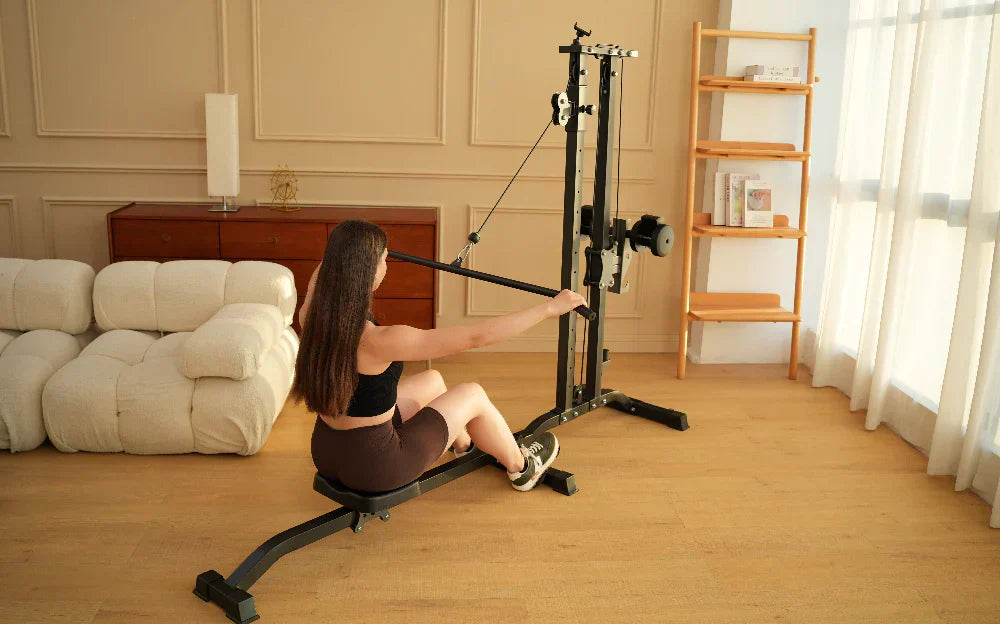
Tousains cable machine CR63 is foldable for space saving
Control and Smoothness
In a 2:1 cable machine, the weight moves at half the speed of your hand, which means it has less momentum and results in a smoother and more fluid motion. In a 1:1 pulley ratio, however, the weight moves at the same speed as your hand, and it can create a jerky feeling if you pull fast and stop.
1:1 vs 2:1 Pulley Ratio: Pros and Cons
1:1 Pulley Ratio
Pros:
- Direct resistance: you lift exactly what's on the weight stack
- Better for heavy strength training
- Simpler cable system
- Space efficient: the weight doesn't need to travel twice as far for the same movement.
Cons:
- Can feel less smooth or slightly jerky when performing explosive movements
- Less precision and harder to manage for beginners
- Less suitable for high-rep or isolation exercises
2:1 Pulley Ratio
Pros:
- Smoother and more controlled resistance
- Better for isolation and functional training
- Longer cable travel allows for a greater range of motion
- Finer adjustments thanks to the halved weight
Cons:
- You're lifting less actual weight (half of the stack)
- May not be ideal for those focused on max strength
1:1 vs 2:1 Cable Machine Pulley Ratio: Which Is Right for You
So, how do you determine the pulley ratio on a cable machine and, more importantly, which one should you choose?
A 1:1 pulley ratio is better if your focus is on lifting heavier weights and maximizing resistance. A 2:1 pulley ratio, on the other hand, is better suited for functional training, isolation exercises, and smoother, more controlled movements.
For most home gym users, versatility tends to matter more than raw load. That's where a 2:1 system stands out—it's more beginner-friendly, easier to control, and suitable for everything from strength work to isolation and functional training.
If you haven't decided which 2:1 cable machine to purchase yet, a standalone cable machine like the Tousains CR63 is worth considering. This cable machine with weights is designed to be foldable, movable, and space-saving, so you can fold it up after your session and move it to any corner of your home gym or basement.
It also offers a practical balance between functionality and cost, making it a more affordable cable machine compared to many larger home gym systems. If you're looking for a compact, versatile setup without sacrificing performance, it's a solid choice for building your home gym.
FAQs
What is the difference between a single pulley and a double pulley system?
A single pulley system typically refers to a 1:1 ratio, where the resistance you feel matches the weight on the stack. It provides a more direct and heavier lifting experience, which is often preferred for pure strength training.
A double pulley system usually indicates a 2:1 ratio. In this setup, the resistance you pull is half of the weight stack. The movement is usually smoother and great for isolation and functional training movements.
What does a 2:1 ratio mean on a cable machine?
A 2:1 ratio means that the resistance you feel is about half of the weight selected on the stack. For example, if you choose 100 lbs, you'll be lifting roughly 50 lbs at the handle. It often means smoother resistance, finer weight adjustments, and better control throughout each movement.

