
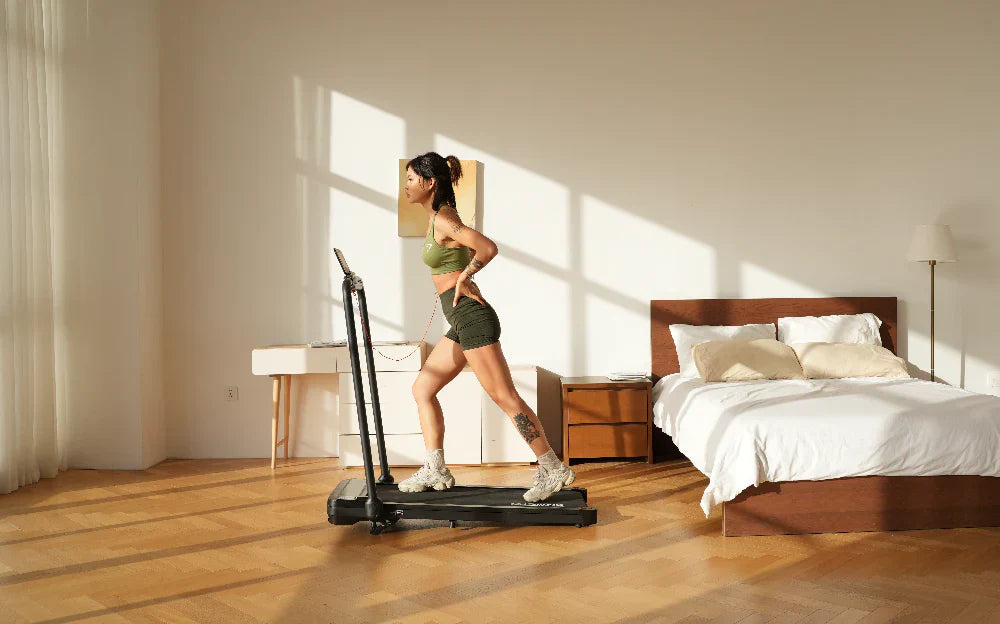
When people think about running, they often picture high calorie burn, soaked T-shirts, flushed faces, and repetitive impact on the knees. This raises a common concern: are treadmills actually bad for your knees? What are the side effects of a treadmill on the knees?
In this article, we’ll break down what science really says, explain common causes of sore knees from running on a treadmill, and show how the right option, Tousains treadmill with incline ENT-T250, can actually help protect your joints rather than harm them.
What Science Says: Are Treadmills Bad for Your Knees?
Scientific findings on treadmill running and knee health vary depending on training intensity. Here’s what different studies show:
Study 1: Moderate running exercise augments glycosaminoglycans and the thickness of articular cartilage in the knee joint of young beagle dogs. [1]
Study 2: High-intensity running for six weeks may lead to cartilage degradation in a rat model. It also showed that an MMP-3 selective inhibitor may be an effective option for retarding such osteoarthritic changes. [2]
Study 3: Twenty-four male Wistar rats were randomly divided into four groups: sedentary (SED), low-intensity (LIR), medium-intensity (MIR), and high-intensity running (HIR). After 8 weeks of treadmill running training, LIR and MIR groups showed significantly increased cartilage thickness, chondrocyte count, and GAG content compared to the SED group. In contrast, the HIR group exhibited decreases in these parameters. [3]
Although these studies were conducted on animal models, they consistently highlight one key pattern: knee cartilage responds positively to low and moderate loads, while high loads may increase risk over time.
Sore Knees from Running on a Treadmill: Common Reasons & How to Avoid Them
In most cases, knee discomfort is caused by how you run, not the treadmill itself. Below are the most common reasons treadmill users develop knee pain, and what you can do to prevent it.

Wearing the Wrong Shoes
Running shoes play a much bigger role in knee health than most people realize. Shoes that are worn out, lack cushioning, or don’t match your running gait can increase impact forces traveling from your feet to your knees.
How to avoid it:
- Replace running shoes every 300–500 miles
- Choose shoes with proper shock absorption and arch support
Poor footwear is one of the fastest ways to develop sore knees from treadmill running, especially for beginners.
Incorrect Treadmill Settings
Running at a completely flat incline (0%) may feel easier, but it can place repetitive stress on your knees due to unnatural stride mechanics. Similarly, running too fast before your body adapts increases joint load.
How to avoid it:
- Set a slight incline (1–2%) to reduce knee strain and mimic outdoor running
- Start at a comfortable speed and increase gradually
- Avoid sudden jumps in speed or incline
Overstriding and Heavy Heel Strikes
Overstriding, which means landing with your foot far ahead of your body, creates excessive braking forces that travel directly to your knees. This issue is common on treadmills because the belt “pulls” your foot backward.
How to avoid it:
- Shorten your stride and increase cadence slightly
- Aim to land with your foot under your hips, not in front of you
- Focus on a soft, controlled foot strike
Overuse and Lack of Recovery
Even with perfect form, running too often or increasing volume too quickly can overload the knee joint. This is a common cause of sore knees from treadmill workouts, especially among new runners.
How to avoid it:
- Follow the 10% rule: don’t increase distance or time by more than 10% per week
- Schedule rest days or low-impact cross-training sessions
- Listen to early warning signs like stiffness or mild pain
Your knees need recovery time to adapt, just like muscles do.
Poor Running Posture
Slouching, excessive forward lean, or stiff upper-body posture can shift extra stress to your knees. Poor posture also reduces running efficiency, making each step more taxing on the joints. Good posture helps distribute impact more evenly across the body.
How to avoid it:
- Keep your chest upright and shoulders away from your ears
- Engage your core lightly while running
- Avoid gripping the treadmill handrails
Runner’s Knee (Patellofemoral Pain Syndrome)
Runner’s knee is one of the most common treadmill-related knee issues. It’s often caused by muscle imbalances, particularly weak glutes and quads, which lead to improper knee tracking.
How to avoid it:
- Strengthen glutes, quads, and hamstrings through weight training
- Reduce mileage temporarily if pain persists
- Stay hydrated to improve muscle performance
Knee-Friendly Alternatives to Running
If running still feels uncomfortable, there are excellent low-impact options that reduce knee stress while producing the same results.
Elliptical Machine: The guided and smooth motion of elliptical machines makes them ideal for joint-sensitive users, even people with knee arthritis.

Stationary Bike: Cycling places minimal compressive force on the knees and allows precise resistance control. Tousains foldable exercise bike offers a compact and low-impact solution that complements treadmill training and supports knee recovery days.
Stay Fit While Protecting Your Knees with Tousains
The truth is, treadmills themselves aren’t bad for your knees; poor setup and training habits are. With the tips on how to avoid them, you can build your endurance on treadmills while protecting your knees.
If you are looking for the best treadmill for knees, the Tousains treadmill with incline ENT-T250 is the go-to choice. The cushioned system and various speed settings make sure that you can enjoy your treadmill running/jogging/walking in a safe way. For anyone who’s not sure where to get started, download the Tousains app, and you'll have access to various training courses for different weights and goals.
Explore more details of the Tousains treadmill with incline ENT-T250 and claim yours today!
FAQ
Is treadmill walking bad for your knees?
No. Walking at a moderate speed places far less impact on the knee joints than running, and most treadmills offer better shock absorption than hard outdoor surfaces. Using a slight incline (around 1–3%) can further improve knee mechanics by encouraging a more natural gait and reducing repetitive stress. To avoid any unnecessary pain in the knees, follow the tips mentioned in this article.
Is incline on a treadmill bad for knees?
A moderate incline is often beneficial for knee health. Inclines between 1–5% can reduce impact forces by shortening stride length and encouraging better posture. This is why a treadmill with an incline is often recommended.
However, excessive incline, especially at high speeds or for long durations, can increase joint load and strain the knees. The key is balance.
References:
[1] https://pubmed.ncbi.nlm.nih.gov/3278079/
[2] https://pubmed.ncbi.nlm.nih.gov/22114772/
[3] https://pmc.ncbi.nlm.nih.gov/articles/PMC3892754

